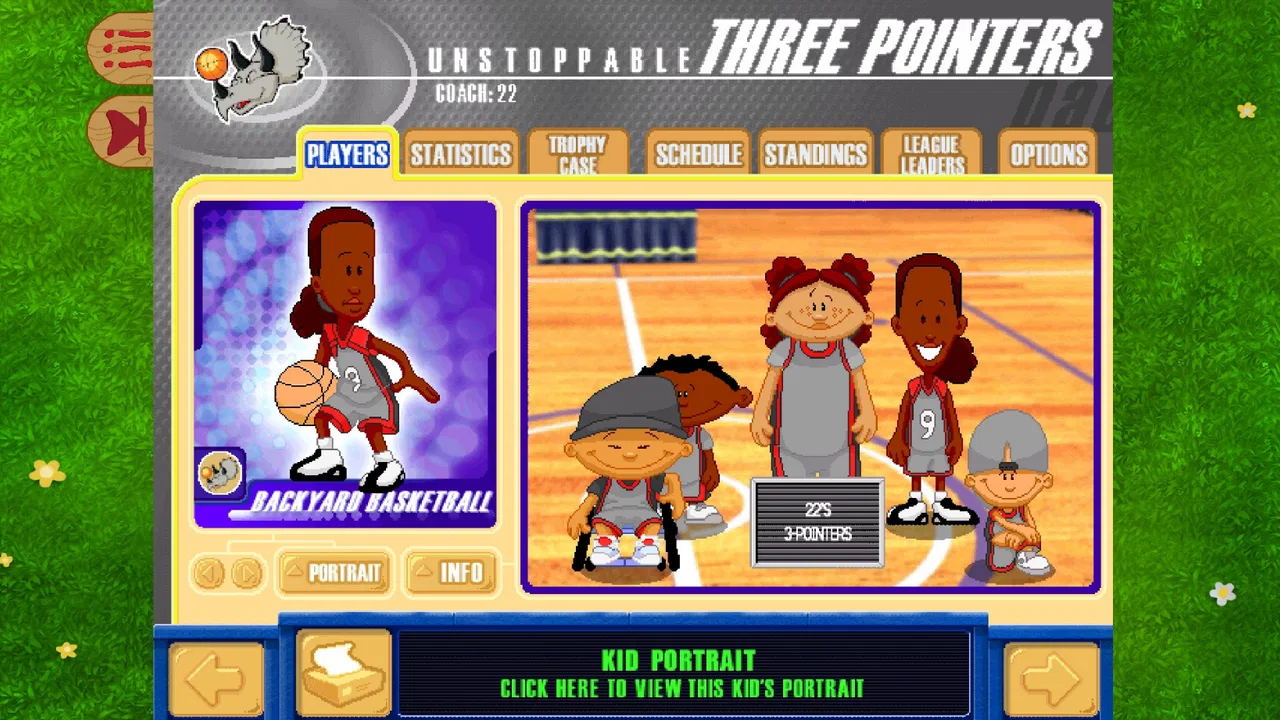
Backyard Basketball '01
- 3.7
- Rating
- 10.00K
- Installs
- Free
- Price

 Analysis by App-foxy
I went into Backyard Basketball '01 expecting a simple sports game with a strong retro identity, and that is exactly where it makes its best impression. This is a free basketball game from Playground Productions LLC that brings the classic Backyard Basketball 2001 experience to modern systems. It is aimed at players who want quick, characterful basketball rather than a full professional simulation with a long list of management screens.
The appeal becomes clear as soon as I start a game. I am not spending the opening minutes building a franchise, comparing complicated statistics, or learning a huge control scheme. I get to the court, make a play, react to what happens, and decide whether I want another attempt. That short path from starting the game to taking action is the foundation of its charm.
It is also a very specific kind of sports game. The age rating is Everyone, so it is suitable for a broad audience, including younger players and families looking for something lighter than a realistic basketball simulation. At the same time, older players may be the ones who connect most quickly with its presentation and old-school atmosphere. My recommendation depends less on whether you love basketball simulations and more on whether you enjoy compact, accessible arcade-style play.
You May Also Like

 Pandora - Music & Podcasts
Pandora’s Music Is Easy to Start, but Harder to Recover
Pandora’s strength is its low-effort path from a seed to a station. Its weak spot is how much confidence it asks you to place in connection, setup, and quiet recovery.

 8 Ball Pool
 Is Built on Rivalries, Rematches, and Routine
A close look at the rivalries, rematches, shared routines, and unanswered safety questions that turn a quick pool match into a persistent mobile community.

 Samsung Music
’s Quiet Strength Is Playing What You Already Own
Its reach comes less from spectacle than from dependable access to a personal library. That simplicity is both the app’s strongest retention engine and its ceiling.

 AccuWeather: Weather Radar
AccuWeather Review: A Quick, Clear Forecast for Everyday Decisions
For everyday plans, the best forecast is the one you can understand quickly. AccuWeather makes rain timing, radar, and local conditions easy to act on, with a few trade-offs.

 Hill Climb Racing
Why Hill Climb Racing Still Turns Crashes Into One More Run
A tiny car, a bumpy hill and one more upgrade: Hill Climb Racing keeps resurfacing because its simple chaos makes every near-miss feel personal.

 AliExpress - Shopping App
AliExpress Makes Global Shopping Feel Personal, but Shoppers Bear the Risk
AliExpress turns a global marketplace into a pocket-sized discovery engine. Its reach is useful, its shopping loop compelling, and its trade-offs easy to miss.
More From Our News Desk
View All News


How the basketball loop feels from the first play
I find the first few possessions are most useful when I treat them as a chance to learn the game’s pace, rather than as a test of how quickly I can score. Watching how each choice shapes the next moment gives me a clearer feel for when to act and when to wait. That hands-on rhythm is the starting point; the next section looks at what makes the game’s feedback satisfying, and where it can still ask for patience.
The first action is deliberately approachable
My first useful observation is that the game does not need a long explanation to communicate its purpose. The basketball is the focus, and the early experience is about trying actions, seeing the response, and adjusting. That makes it easy to hand the device to someone else for a quick match without turning the introduction into a lesson.
This simplicity is a strength when I have only a short break. A realistic basketball game often asks me to remember several systems before I can enjoy a possession. Here, the immediate goal is easier to understand: move the players, create an opportunity, and make the next play better than the last one. The result is a game that feels comfortable for casual sessions.
That does not mean every moment is effortless. Basketball still depends on timing and positioning, and a rushed decision can turn a promising attack into a missed chance or a lost possession. The important difference is that the game lets me learn through repetition instead of burying the useful part of the experience under menus and instructions.
I found that the best way to approach the opening is to resist the urge to play every possession at maximum speed. A quick attempt may be exciting, but observing how the players respond gives me more useful information. When I slow down for a moment, I can recognize where an opening is developing and choose a better action instead of treating every possession like a desperate shot.
Feedback arrives through the next possession
The feedback rhythm is what keeps the game moving. I try something, the play produces a result, and that result immediately changes my next decision. A successful action gives me a reason to repeat the idea under slightly different circumstances. A poor action tells me to change my timing, positioning, or choice on the following possession.
That rhythm matters more here than a large collection of modes would. The pleasure comes from the small corrections between attempts. I may begin by forcing shots because I want a fast result, then realize that creating a cleaner opportunity is more satisfying. I may also learn that a familiar approach stops working when the opposing side closes the space more effectively.
For me, this is where the retro design works best. The game does not feel as though it is trying to overwhelm me with information. It encourages attention to the court and to the immediate consequence of each decision. That makes the feedback easy to understand, even when the result is not the one I wanted.
There is a useful difference between readable feedback and perfect control. I can generally understand why a possession went badly, but understanding the problem does not always make the correction instant. Players expecting modern sports games to provide extremely precise control assistance may find the experience less forgiving. I see that as part of the older character, although it can become frustrating when I am trying to execute a specific idea repeatedly.
Why the reward is not only the scoreboard
The obvious reward is winning a game, but the more durable reward is improvement within a match. I enjoy recognizing that a decision I mishandled earlier now works because I approached it with more patience. That kind of progress is modest, but it gives a short session a clear sense of purpose.
The game also rewards familiarity. The more I understand its pace, the less I treat each possession as an isolated event. I begin to think about what I want to create next rather than simply reacting to the current movement. That shift makes the experience more engaging without requiring a complicated progression system.
For younger players, the reward can be even more direct: make a play, see the result, and try again. Because the game is free and carries an Everyone rating, it is easy to imagine it being used as a relaxed family game rather than as a demanding competitive product. I would still sit with a new player for the first session, not because the concept is difficult, but because a little guidance can help them understand the rhythm faster.
My practical tip is to treat the first few games as experiments rather than tests. Trying to win immediately can make every mistake feel larger than it is. Instead, I would focus on one improvement at a time, such as waiting for a better opening or avoiding rushed choices. That approach makes the feedback more useful and gives the next game a clear reason to exist.
The reset is part of the appeal
After a game ends, I do not feel locked into a long commitment. The natural reset is one of the strongest reasons to return. I can finish a session, put the device down, and come back later without needing to reconstruct a complicated campaign or remember several unfinished tasks.
This makes it a good companion for everyday gaps in the day. I could play during a short rest, after finishing a chore, or while waiting for someone, because the core loop does not demand that I reserve an entire evening. The game gives me a complete basketball experience in a compact format, then lets me start fresh when I want another attempt.
The reset also helps with experimentation. If I make poor decisions early, I do not have to carry that frustration into a long sequence of matches. I can use the next session to change my approach immediately. That clean restart is especially useful for players who like learning by doing rather than reading strategy guides.
There is a trade-off, though. Players who need a deep long-term structure may find the reset less exciting than I do. If your ideal sports game is built around extensive team development, a large career journey, or constant statistical planning, this compact format may feel limited. The reset is satisfying because it is quick, but it also means the experience is centered on the match itself rather than on a large surrounding system.
Where it fits among basketball alternatives
Compared with modern professional basketball games, this feels much less concerned with realism and presentation scale. Those alternatives are better choices if I want official-style competition, elaborate team management, detailed player development, or a simulation that asks me to study many systems. They can offer more depth, but they also require more time and attention before the fun begins.
Compared with a very minimal arcade basketball game, this has more personality because its identity comes from the classic Backyard Basketball setting. It is not simply a generic shooting challenge. The retro foundation gives the experience a particular tone, and that makes it more memorable than a disposable game built only around quick taps or repeated attempts.
The most important comparison is therefore about commitment. I would choose this when I want a recognizable basketball game that starts quickly and lets me play in short bursts. I would choose a larger alternative when I want a long-term hobby with deeper customization and a more demanding simulation layer. Neither choice is automatically better; they serve different moods.
One of the less obvious strengths is how well that distinction clarifies the game’s audience. It is not trying to replace every other basketball product on a phone or tablet. Its value comes from being approachable, self-contained, and easy to revisit. That focus helps it avoid some of the friction that often makes sports games feel like chores.
Who should play, and who should skip it
I think it is a strong fit for fans of classic sports games, families wanting an accessible basketball title, and players who prefer short sessions with a clear beginning and end. It also suits people who enjoy improving through repeated attempts rather than unlocking a large number of layers around the main activity.
I would be more cautious if you only enjoy current-generation basketball simulations. The older design and simpler presentation may feel too restrained if you expect a detailed professional league experience. The average rating is 3.7 from over a hundred ratings, which suggests a mixed but generally workable reception rather than universal enthusiasm. I would interpret that as a reason to keep expectations realistic: the game’s appeal depends strongly on liking its classic approach.
The install base is over ten thousand, so it has found an audience without presenting itself as a massive mainstream release. That makes it feel more like a focused revival for interested players than a universal recommendation. The price helps remove the biggest barrier to trying it, but free access alone does not make the game suitable for everyone.
I would also skip it if I wanted a game that explains every tactical detail through extensive tutorials. Its learning process is more hands-on. I prefer that style for a quick sports game, but players who want a guided, highly structured introduction may need patience while they discover how to get the most from each possession.
Practical details before installing
The game is free, which makes sampling it straightforward. It was released on March 17, 2025, and version 1.1.95 is the current version I would look for when checking compatibility and updates. It supports Android 5.0 and later, so the minimum operating-system requirement is relatively broad for Android users with older devices.
Those technical details matter because this is the kind of game I would install for convenience rather than for a long setup process. Before starting, I would make sure the device has enough free space and that the operating system meets the requirement. Once that is handled, the main question is not whether the game is technically ambitious, but whether its classic basketball loop matches the kind of session I want.
I would also recommend deciding in advance what you want from the first play. If you are testing it for nostalgia, pay attention to the atmosphere and the way the match structure encourages quick restarts. If you are introducing it to a child, focus on one action at a time and let them discover the results. If you are comparing it with a modern simulation, judge it on accessibility and immediacy rather than on the number of systems it includes.
The small habits that make sessions better
My first useful habit is to avoid judging the game after a single rushed possession. The loop becomes clearer when I give myself enough time to notice how an action affects the next moment. A failed attempt is not just a negative result; it is information about what I should alter when the session resets.
My second habit is to use the reset as a learning tool. Rather than repeating the same approach automatically, I would deliberately change one decision in the next game. That makes it easier to tell whether the improvement came from better timing, better positioning, or simply a fortunate result. It turns a quick rematch into a small experiment.
My third tip is for shared play. When another person is trying the game, avoid taking over the controls too quickly. The accessible design is more enjoyable when the new player can see the connection between an action and its consequence. A short explanation followed by room to experiment is better than turning the first match into a lecture.
Finally, I would keep the game installed for the moments when I want a familiar activity without a major time commitment. Its greatest practical advantage is not complexity; it is the ease of returning to the court. That makes it useful as a break-time game, a nostalgia pick, or a casual option for someone who does not normally play sports titles.
My verdict on the complete action-feedback-reset loop
After spending time with it, I see Backyard Basketball '01 as a focused revival rather than a modern basketball replacement. The first action is easy to understand, the feedback arrives quickly enough to support experimentation, the reward comes from better decisions as well as results, and the reset makes another session feel natural.
Its limitations are tied to the same design choice that gives it character. The experience may feel too simple for players who want a deep professional simulation, and the older control feel can demand patience when a precise play does not work immediately. I would not recommend it to someone searching for a huge career mode or an exhaustive tactical system.
For me, the game succeeds when I want basketball that gets out of the way and lets me play. It is free, broadly accessible, and specific enough to stand apart from anonymous arcade titles. If the idea of a classic Backyard Basketball experience on a modern system sounds appealing, I think it is worth trying. Just approach it for its quick, repeatable match loop, not for features it was never designed to prioritize.
The final question is simple: after a session ends, do I want to start another one? In this case, usually yes. The answer comes from the clean cycle of action, consequence, adjustment, and restart. That compact loop is the game’s real reward, and it is also the clearest reason I would recommend it to a friend who wants an approachable sports game with a retro feel.
FAQs for Backyard Basketball '01
01What platforms is Backyard Basketball '01 available on?
Backyard Basketball '01 is available for both Android and iOS devices. Users can download the game through the Google Play Store for Android or the App Store for iOS. Ensure your device meets the necessary system requirements to enjoy a smooth gaming experience.
02Is Backyard Basketball '01 suitable for children?
Yes, Backyard Basketball '01 is designed to be family-friendly and is suitable for children. The game features fun, cartoonish graphics and simple controls that are easy for younger players to understand. Parental guidance is recommended to monitor in-app purchases or ads.
03Does Backyard Basketball '01 have multiplayer features?
Backyard Basketball '01 offers both single-player and multiplayer modes. You can enjoy playing against AI opponents or challenge your friends in local multiplayer mode. Unfortunately, the game does not support online multiplayer, so all multiplayer sessions must be on the same device.
04Are there any in-app purchases in Backyard Basketball '01?
Yes, Backyard Basketball '01 includes in-app purchases. Players can buy additional content like new characters, outfits, and court upgrades. While the game is free to download, these purchases can enhance gameplay and offer a more personalized experience. Users should manage these purchases responsibly.
05What are the main features of Backyard Basketball '01?
Backyard Basketball '01 features a variety of gameplay modes, including quick play, tournaments, and skills challenges. It boasts a roster of quirky characters, each with unique abilities, and customizable courts. The game also includes simple, intuitive controls and vibrant graphics that make it accessible and engaging for players of all ages.
Pros
- Nostalgic graphics bring a classic feel.
- Simple controls make it easy to pick up.
- Variety of characters adds charm.
- Fun mini-games enhance replayability.
- Kid-friendly design suitable for all ages.
Cons
- Limited strategic depth for older players.
- Graphics may seem outdated to some.
- No multiplayer mode available.
- Lack of updates or new content.
- Soundtrack can become repetitive.

Backyard Basketball '01
Gallery